4-in-1 ESC: Benefits, Design, and FPV Drone Applications
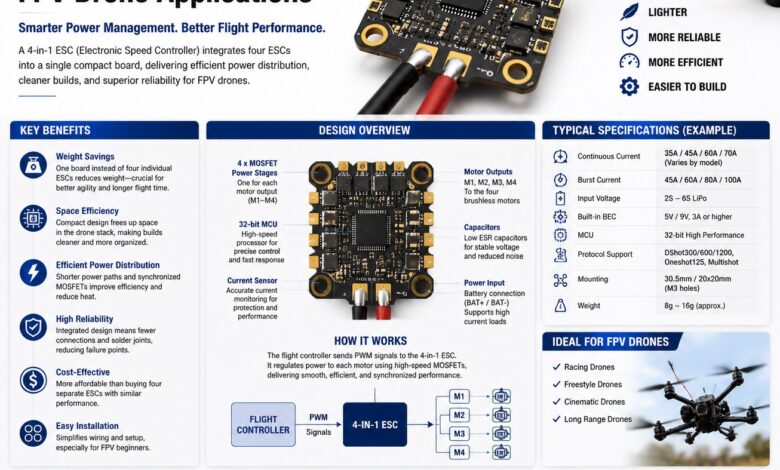
A 4-in-1 ESC is one of the most practical and space-saving components used in modern FPV drones. Instead of installing four separate electronic speed controllers, builders can use one compact circuit board to control all four motors. This integrated approach simplifies wiring, reduces weight, and creates a cleaner internal layout. For pilots who want responsive performance, efficient power delivery, and an easier building process, the 4-in-1 configuration offers a strong combination of convenience and capability. It has become especially valuable in racing, freestyle, cinematic, and custom-built drones where every gram and every millimeter of space can influence flight behavior.
The purpose of an electronic speed controller is straightforward: it regulates how much electrical power reaches each motor. However, the process happening inside the board is highly precise. The flight controller continuously sends signals based on throttle movement, stabilization calculations, and pilot input. The ESC interprets those signals and adjusts motor speed within fractions of a second. By placing four control channels on one board, a 4-in-1 design allows the entire propulsion system to operate as a coordinated unit. This makes installation more organized while supporting the fast motor responses needed for stable and agile FPV flight.
4-in-1 ESC development at Shenzhen Rich Full Joy Electronics Co Ltd reflects the growing demand for compact, dependable, and performance-focused electronics used in FPV drone systems. A well-designed board must manage substantial current, rapid switching activity, vibration, and heat without interrupting motor control. That requires careful circuit planning, suitable copper thickness, reliable components, and effective thermal management. When these elements work together, the ESC becomes more than a convenient board—it becomes the electrical foundation that keeps four motors synchronized throughout demanding flights.
What Makes a 4-in-1 ESC Different?
A traditional drone setup may use one individual ESC for each motor. Although separate controllers can work well, they require more wires, more soldering points, and more mounting space. A 4-in-1 ESC combines those four controllers into a single board, usually positioned beneath or near the flight controller. The result is a compact stack that fits neatly inside the central frame.
This design provides several immediate advantages. Motor wires connect directly to one board, battery power enters through a centralized input, and signal connections can often be handled through a small cable or clearly organized solder pads. Builders spend less time routing wires around the arms, and the finished drone looks more professional.
The integrated layout also helps maintain consistency between motor channels. Since all four ESC circuits are produced on the same board and operate under similar conditions, their electrical characteristics can be closely matched. That consistency supports smooth acceleration, balanced thrust, and predictable handling.
Key Benefits of Using a 4-in-1 ESC
1. Reduced Weight
Weight is critical in FPV drone design. A lighter aircraft can accelerate faster, change direction more quickly, and often use battery power more efficiently. Four separate ESCs require individual circuit boards, insulation, signal wires, and power connections. Combining them into one board eliminates much of that duplicated material.
The weight reduction may appear small when viewed as a single component choice, but FPV performance often depends on many small improvements working together. Saving a few grams in the electronics stack can help builders select lighter frames, smaller protective parts, or more efficient battery configurations.
A lower overall weight can also reduce the workload placed on the motors during normal flight. When the propulsion system does not need to lift unnecessary mass, it can respond more efficiently to throttle changes.
2. Cleaner Wiring
A tidy wiring layout is not only attractive; it can also improve reliability. Excess wiring may rub against frame edges, move into contact with rotating parts, or make repairs more difficult. With a 4-in-1 ESC, the motor leads are routed toward one central location, while power and control connections remain grouped together.
This simplified arrangement makes troubleshooting easier. Builders can inspect solder joints, identify damaged wires, and test motor outputs without tracing several independent controllers across the frame. A clean build also improves airflow through the center of the drone, which can assist with cooling.
Fewer external connections mean fewer opportunities for loose joints or damaged insulation. Careful installation is still essential, but the integrated structure reduces unnecessary complexity.
3. Faster Assembly
Building an FPV drone requires patience, precision, and accurate soldering. A 4-in-1 ESC can shorten the assembly process because the builder does not need to mount and connect four separate control boards. Once the integrated unit is secured in the stack, the main tasks are connecting battery power, attaching the motor wires, and linking the ESC to the flight controller.
This efficient workflow is useful for experienced builders producing several drones, but it is equally helpful for beginners. Fewer components make the layout easier to understand. The builder can focus on creating strong solder joints, maintaining correct polarity, and checking the system carefully before powering it.
Faster assembly does not mean careless assembly. The best results still come from measuring wire lengths, using suitable soldering temperatures, and inspecting every connection.
4. Compact Stack Design
Space inside an FPV frame is limited. Cameras, receivers, video transmitters, antennas, capacitors, and power wires must all fit securely without interfering with one another. A 4-in-1 ESC supports a compact stack arrangement by placing motor-control electronics directly under or above the flight controller.
This central placement creates more room on the frame arms and allows designers to produce narrower, lighter structures. It also protects the ESC from direct impacts better than some arm-mounted layouts. Proper spacing and soft mounting can help reduce mechanical stress while maintaining useful airflow around the board.
Compact design is particularly important for small FPV drones, where every component must serve its purpose without wasting space.
Important Design Elements
Current Rating
The current rating indicates how much electrical load the ESC can handle. Each motor can draw a substantial amount of current during rapid acceleration, steep climbs, or recovery from aggressive maneuvers. The ESC must provide enough capacity for these peaks without overheating or becoming unstable.
Choosing a suitable rating requires considering motor size, propeller size, battery voltage, aircraft weight, and flying style. A gentle cinematic drone may place different demands on the ESC than a racing build with high-speed motors and aggressive propellers.
A sensible design includes operating headroom rather than selecting a controller that barely meets expected requirements. Additional capacity helps the board manage short bursts of current and demanding flight conditions more confidently.
Battery Voltage Compatibility
FPV drones use different battery configurations, and the ESC must be compatible with the intended voltage range. Applying more voltage than the board is designed to handle can damage power components almost immediately. Builders should confirm compatibility before connecting a battery.
Higher-voltage systems can deliver strong power while keeping current lower for a given output, but every component in the system must support the selected configuration. The motors, flight controller, capacitor, and ESC should work together as a matched electrical system.
Clear voltage planning improves safety, reliability, and long-term performance.
Thermal Management
Heat is one of the main challenges in compact electronic systems. During flight, the switching components on an ESC repeatedly control large amounts of current. This process naturally generates heat, especially under heavy throttle or when airflow is limited.
Effective thermal design may include optimized copper areas, suitable board thickness, efficient component placement, and enough spacing for ventilation. Builders can support cooling by avoiding tightly packed wiring directly over heat-producing areas.
Motor condition also affects ESC temperature. A damaged motor, bent shaft, oversized propeller, or mechanical obstruction may increase current draw. Monitoring unusual heat can therefore help identify problems elsewhere in the drone.
Power Filtering
Rapid motor switching can create electrical noise and voltage spikes. If these disturbances move through the drone’s power system, they may affect video quality, sensor readings, or other sensitive electronics. Good filtering helps maintain cleaner power delivery.
A capacitor installed near the battery input can absorb some of the sudden voltage changes created during demanding motor activity. Short power leads, strong solder joints, and proper component placement also contribute to electrical stability.
Clean power is especially valuable for FPV systems because pilots depend on a clear video feed and accurate control signals. A stable electrical environment supports both.
FPV Drone Applications
Racing Drones
Racing drones need immediate throttle response, low weight, and compact construction. A 4-in-1 ESC supports these goals by centralizing motor control in a lightweight board. The reduced wiring can make the aircraft easier to maintain between races, while the compact stack leaves more room for other essential equipment.
During racing, pilots frequently move between low and high throttle in very short intervals. The ESC must respond rapidly and consistently so the aircraft follows commands without hesitation. Reliable motor synchronization helps the drone hold its intended line through gates, turns, and sudden elevation changes.
A carefully matched ESC, motor, propeller, and battery combination can produce a smooth but powerful racing setup.
Freestyle Drones
Freestyle flying places unique demands on electronics. Pilots perform rolls, dives, flips, reversals, and rapid recoveries, often switching motor output aggressively. A 4-in-1 ESC can provide the coordinated response needed for these maneuvers while maintaining a neat and durable build.
Freestyle drones also experience impacts. Central mounting can give the ESC some protection from direct contact, although strong frame construction and proper installation remain important. Easy access to motor pads and connectors can make field repairs more manageable.
Smooth throttle control is especially valuable in freestyle because it helps pilots shape each movement precisely rather than simply producing maximum speed.
Cinematic FPV Drones
Cinematic FPV flying focuses on controlled movement, stable footage, and predictable power delivery. While these drones may not always require extreme acceleration, they benefit from smooth motor response and dependable operation.
A 4-in-1 ESC keeps the central electronics organized and can reduce the amount of exposed wiring in the frame. This helps builders create clean layouts around cameras, stabilization systems, and protective structures.
For cinematic applications, reliability often matters more than maximum performance. Selecting an ESC with suitable current capacity and strong thermal characteristics can help the drone maintain steady operation during longer, carefully planned flights.
Long-Range Builds
Long-range drones depend on efficiency and reliability. An electrical failure far from the pilot can lead to the loss of the aircraft, so component selection and installation deserve careful attention. A 4-in-1 ESC reduces wiring complexity and creates a centralized system that is easier to inspect before flight.
Efficiency depends on the entire propulsion combination. Motors, propellers, battery voltage, aircraft weight, and cruising speed all influence power consumption. The ESC should support the expected load without operating close to its limits for extended periods.
A well-prepared long-range build should also include secure wiring, effective filtering, adequate cooling, and thorough preflight testing.
How to Choose the Right 4-in-1 ESC
Start by identifying the drone’s intended purpose. A racing aircraft, freestyle build, cinematic platform, and long-range drone each create different electrical demands. Next, check the battery voltage, motor specifications, and expected current draw. The ESC should comfortably support the planned setup.
Consider the following points before making a selection:
- Voltage support: Confirm that the board matches the intended battery configuration.
- Continuous current capacity: Select a rating with enough margin for normal and demanding flight.
- Burst capability: Ensure the board can tolerate brief periods of higher current.
- Physical dimensions: Check that the mounting pattern and board size fit the frame.
- Connection layout: Review the positions of motor pads, power terminals, and signal connections.
- Cooling conditions: Make sure the installed board will receive reasonable airflow.
- Build quality: Look for solid solder pads, organized component placement, and protective design features.
These checks help create a balanced system instead of relying on one impressive specification.
Installation Tips for Better Reliability
Careful installation plays a major role in ESC performance. Begin by inspecting the board for visible damage or loose components. Use mounting hardware that secures the stack without bending the circuit board. Avoid overtightening screws, as excessive pressure can damage the board or create electrical contact with the frame.
Trim motor wires to practical lengths, but leave enough flexibility for maintenance. Clean solder joints should look smooth and fully cover the intended pad without spreading to nearby connections. Battery leads require particular attention because they carry the highest current.
Before connecting a full battery, check for short circuits with an appropriate testing method. Confirm polarity several times. A simple wiring mistake can damage multiple components instantly.
Keep signal wires away from sharp edges and moving parts. Where necessary, secure cables so they cannot shift during vibration or impact. Good installation turns a capable ESC into a dependable part of the aircraft.
Maintenance and Troubleshooting
A 4-in-1 ESC requires little routine maintenance, but regular inspection can prevent small issues from becoming serious failures. Check solder joints after hard crashes, especially around battery and motor connections. Look for damaged insulation, loose wires, dirt buildup, or signs of overheating.
If one motor behaves differently from the others, begin by inspecting the motor itself and its wiring. Swap components carefully during testing to determine whether the problem follows the motor or remains on the same ESC channel. This process helps separate mechanical issues from electronic ones.
Unusual motor sounds, excessive heat, sudden desynchronization, or inconsistent startup behavior should not be ignored. These symptoms may indicate incorrect settings, damaged motor windings, poor solder joints, or an overloaded power system.
Keeping the board clean and dry also matters. Moisture, conductive debris, and metal fragments can create short circuits. Protective coatings may improve resistance to environmental exposure, but they do not replace proper care.
Why the 4-in-1 ESC Remains a Smart Choice
The 4-in-1 ESC has earned a central place in FPV drone design because it solves several practical problems at once. It reduces weight, simplifies wiring, saves space, and supports organized construction. At the same time, it delivers the rapid, coordinated motor control required for modern flight performance.
Its value extends across many applications. Racers appreciate the compact format and quick response. Freestyle pilots benefit from smooth power delivery and easier repairs. Cinematic operators gain a cleaner internal layout, while long-range builders can create efficient systems with fewer external connections.
The best results come from thoughtful system matching. Current rating, voltage support, cooling, motor choice, propeller load, and installation quality must all be considered together. When those factors are balanced, a 4-in-1 ESC provides a strong foundation for responsive, reliable, and enjoyable FPV flight.
For more practical guidance on planning and developing FPV drone systems, visit https://www.richpcba.com/blogs/guide-build-fpv-drone-factory-requirements-roadmap/.