Complete Guide to Industrial Steel Pipes: Sizing Schedules, Standards, and Types
Industrial fluid handling, municipal infrastructure, energy transmission, and modern structural engineering depend fundamentally on high-integrity tubular products. Whether conveying pressurized volatile hydrocarbons, distributing potable municipal water, circulating extreme-temperature boiler feedwaters, or serving as load-bearing structural columns, cylindrical conduits must perform reliably under intense internal pressures, mechanical loads, and demanding external environments. The engineering choice of tubular materials directly dictates plant efficiency, workplace safety, and infrastructure longevity across decades of active service.
Modern manufacturing methodologies produce a vast spectrum of tubular geometries, wall thicknesses, and alloy formulations tailored to distinct operational parameters. Specifying the correct tubular solution requires an in-depth understanding of standard sizing terminology, nominal dimensional metrics, metallurgical manufacturing routes, and international design codes. Over-specifying conduit dimensions inflates overall structural weight and procurement costs, whereas under-specifying wall thickness or material chemistry risks pressure containment failures, catastrophic environmental leaks, or costly plant outages.
When procuring certified industrial Steel pipe
products, Shandong Rigang Supply Chain Management Co Ltd provides comprehensive material selections engineered to comply with rigorous engineering specifications across global markets. Sourcing through capable manufacturing and distribution partners ensures that every pipe section maintains tight dimensional tolerances, certified chemical composition, and verified mechanical properties. Having access to an extensive inventory of standard schedules, alloy chemistries, and custom protective finishes enables engineering teams to streamline procurement and maintain project timelines.
Understanding Sizing Schedules and Dimensional Standards
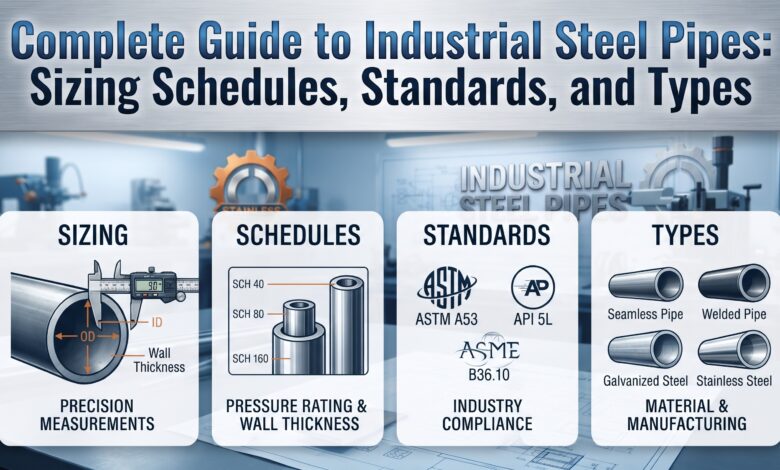
Unlike tubing, which is traditionally designated by its exact outer diameter (OD) and specified wall thickness, industrial piping adheres to standardized sizing conventions that simplify system engineering:
- Nominal Pipe Size (NPS): Developed for North American high- and low-pressure piping systems, NPS is a dimensionless numerical designation. For sizes ranging from NPS 1/8 up to NPS 12, the nominal size loosely corresponds to the approximate inside diameter, while the outer diameter remains constant. For sizes NPS 14 and above, the NPS designation exactly matches the outer diameter in inches.
- Diameter Nominal (DN): Defined under metric standards, DN corresponds directly to the NPS system (for instance, NPS 2 equals DN 50, and NPS 6 equals DN 150), establishing universal interchangeability across metric engineering blueprints.
- Pipe Schedule (SCH): Pipe schedule numbers (such as SCH 10, 40, 80, 120, and 160) designate relative wall thicknesses. As the schedule number increases for a given diameter, the wall thickness increases, which reduces the internal bore while leaving the outer diameter unchanged. This system ensures that valves, flanges, and fittings remain mechanically compatible across various wall thickness specifications.
- Traditional Weight Classes: Older specifications often designate wall thicknesses as Standard (STD), Extra Strong (XS), and Double Extra Strong (XXS). While STD often aligns with SCH 40 and XS with SCH 80 up to certain diameters, engineering drawings increasingly mandate precise schedule numbers or millimeter-based wall thicknesses.
Primary Manufacturing Types and Processing Routes
The manufacturing technique utilized to form the cylindrical profile significantly dictates the pressure ratings, fatigue strength, and economic profile of the pipe:
- Seamless (SMLS) Pipes: Produced by piercing a solid, round cylindrical billet at elevated forging temperatures and elongating it through rotary rolling stands. Because seamless pipes possess no longitudinal or helical weld seam, they exhibit uniform circumferential strength, making them the preferred choice for extreme high-pressure, elevated-temperature, and critical oil and gas refining applications.
- Electric Resistance Welded (ERW) Pipes: Manufactured from continuous steel coils that are progressively cold-formed into a cylinder through roll-forming stands. The longitudinal edges are bonded using high-frequency electrical resistance heating without filler metal, followed by weld seam heat treatment. ERW delivers exceptional dimensional uniformity and consistent wall thickness for mid-pressure transmission and structural tasks.
- Submerged Arc Welded (SAW) Pipes: Used extensively for large-diameter transmission lines. In Longitudinal Submerged Arc Welding (LSAW), individual heavy plates are pressed into cylindrical shapes (via JCOE or UOE methods) and joined with internal and external weld passes beneath a protective granular flux layer. In Spiral Submerged Arc Welding (SSAW), coiled strip is formed helically, creating continuous spiral joints capable of producing massive pipe diameters efficiently.
Key International Standards and Design Codes
Industrial piping must adhere strictly to verified metallurgical and fabrication standards to ensure global interoperability and operational safety:
- ASTM Specifications: Developed by the American Society for Testing and Materials, common benchmarks include ASTM A53 for general-purpose structural and pressure piping, ASTM A106 for elevated-temperature seamless service, and ASTM A333 for low-temperature impact applications.
- API Standards: The American Petroleum Institute governs pipeline integrity for hydrocarbon extraction and long-distance transport. Standards such as API 5L establish stringent chemical, fracture-toughness, and non-destructive testing requirements across PSL 1 and PSL 2 quality tiers.
- ASME Codes: The American Society of Mechanical Engineers defines design rules for process plants, chemical refineries, and power boilers (notably ASME B31.1 and B31.3), dictating allowable stresses, joint efficiencies, and inspection parameters.
- EN and ISO Norms: European and international frameworks (such as EN 10216 for seamless and EN 10217 for welded pipes) govern metallurgical parameters, inspection certificates, and impact toughness across European and global projects.
Major Industrial Applications
Thanks to their structural versatility and dependable flow characteristics, industrial pipes are utilized across diverse applications:
- Energy and Hydrocarbon Logistics: Upstream gathering networks, cross-country transmission lines, and offshore risers move liquid crude, natural gas, and refined fuels across thousands of kilometers under varying climatic conditions.
- Power Plants and Chemical Processing: Superheated steam lines, condenser loops, and chemical reactor feeds demand heavy-wall alloy pipes capable of resisting creep, thermal shocks, and aggressive process fluids.
- Water Distribution and Sewage Systems: Large-diameter welded lines lined with cement mortar or epoxy coatings serve as the backbone for regional aqueducts, municipal treatment facilities, and desalination networks.
- Civil Architecture and Deep Foundations: High-yield tubular sections serve as driven foundation piles, bridge caissons, stadium roof trusses, and port wharf bollards, capitalizing on high torsional rigidity and uniform compressive strength.
Surface Protection and Quality Verification
To ensure long-term durability in corrosive operating environments, pipes frequently undergo specialized surface finishing and thorough non-destructive examination:
- External Protective Coatings: Multi-layer polyethylene (3LPE), fusion-bonded epoxy (FBE), hot-dip galvanizing, and industrial polyurethane barriers shield subterranean and marine pipes from moisture, galvanic currents, and soil stresses.
- Internal Lining Solutions: Liquid epoxy flow linings lower surface friction to boost pumping efficiency, while cement mortar linings prevent internal pitting corrosion in water networks.
- Non-Destructive Testing (NDT): Production facilities utilize full-body ultrasonic scanning, hydrostatic pressure verification, radiographic weld inspection, and electromagnetic eddy-current tests to detect subsurface voids, inclusions, or wall thickness irregularities.
Selecting appropriate pipe dimensions, manufacturing methods, and protective coatings guarantees dependable service under challenging environmental and operational conditions. Working alongside established international suppliers like Shandong Rigang Supply Chain Management Co Ltd allows industrial fabricators, mechanical contractors, and infrastructure developers to obtain fully certified tubular products tailored to complex engineering demands.
For comprehensive details on product availability, technical specifications, and corporate background, please explore https://www.rgsteelfactory.com/about-us/
.