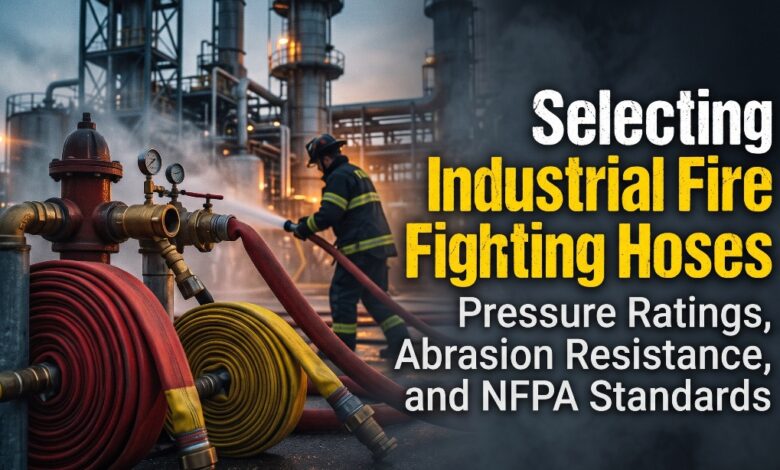
Selecting Industrial Fire Fighting Hoses: Pressure Ratings, Abrasion Resistance, and NFPA Standards
Industrial facilities present unique and severe fire protection challenges. Petrochemical refineries, manufacturing plants, bulk storage depots, logistics warehouses, and marine terminals handle volatile chemicals, combustible dusts, flammable liquids, and heavy mechanical equipment on a continuous basis. Within these demanding operational settings, fire protection infrastructure serves as the primary safeguard for workforce safety, operational continuity, and capital assets. Among the vital firefighting components deployed in any hazard containment strategy, high-performance industrial fire fighting hoses function as the critical lifeline, bridging fixed municipal or plant-wide water supplies directly to the front line of emergency response.
Deploying the proper hose assembly requires a methodical understanding of hydraulic dynamics, polymer science, textile engineering, and regulatory standards. An industrial firefighting incident rarely mirrors a municipal structural fire; response teams regularly encounter high-friction concrete slabs, sharp metal gratings, corrosive chemical spills, and extreme radiative thermal loads. Consequently, selecting an industrial attack or supply hose cannot rely on generalized assumptions or basic aesthetic checks. Facilities must deploy specialized hoses engineered specifically to withstand punishing real-world operating environments while maintaining high volumetric flow rates and absolute structural integrity.
To establish comprehensive safety and dependable hazard mitigation, safety managers and industrial response teams systematically evaluate equipment characteristics against global industry safety benchmarks and verified resource platforms like https://chieffire-safety.com/.
Core Pressure Ratings and Hydraulic Demands
Understanding pressure designations is vital when engineering an industrial fire suppression system. Industrial pumps, fixed standpipe systems, and specialized industrial apparatus produce substantial hydraulic pressures to move high volumes of water across long pipeline runs.
- Working Pressure (Service Pressure): This specification defines the maximum continuous hydrostatic pressure a hose can safely manage during active operational deployment. Industrial operations generally require working pressures spanning 250 psi to 400 psi (17 to 28 bar) for standard attack operations, while high-pressure master stream and long-distance water supply lines may demand even higher thresholds to overcome substantial elevation losses and pipe friction.
- Proof Test Pressure: The proof pressure represents the baseline testing threshold applied to the hose during manufacture and annual recertification cycles. Conducted typically at twice the rated working pressure, this non-destructive hydraulic test confirms the mechanical strength of the textile jacket and the bonding integrity of the inner liner without degrading the tensile matrix of the material.
- Burst Pressure Rating: Burst pressure indicates the ultimate hydrostatic pressure limit at which structural failure occurs. High-grade industrial hoses generally adhere to a minimum safety margin of three to one, meaning a hose rated for a 300 psi working pressure will exhibit a minimum burst pressure of 900 to 1,200 psi. This generous safety margin prevents catastrophic rupture caused by sudden pressure surges or accidental mechanical crushing under load.
- Water Hammer and Surge Mitigation: Rapid closure of quarter-turn ball valves, nozzle shut-offs, and monitor valves introduces violent pressure transients known as water hammer. These instantaneous shockwaves can double or triple the internal line pressure within milliseconds. Selecting hoses engineered with high tensile strength synthetic yarns dampens these transient peaks, protecting both emergency personnel and upstream pump hardware from violent line recoil or burst hazards.
- Friction Loss Optimization: Flow efficiency depends heavily on the internal surface finish of the waterway. Smooth, non-porous liners significantly reduce surface friction, enabling maximum water delivery to the nozzle tip at optimal working pressures without overloading upstream centrifugal fire pumps.
Abrasion Resistance and Outer Jacket Construction
Physical durability determines how reliably a hose survives repeated deployment over harsh industrial surfaces. Industrial plants feature coarse aggregate asphalt, diamond-plate steel platforms, sharp structural steel edges, and gravel-covered yards, all of which rapidly abrade inferior equipment.
- Single Jacket vs. Double Jacket Systems: Single jacket hoses feature a single woven reinforcement sleeve surrounding the inner lining. While lightweight and easy to coil, they are generally reserved for indoor stationary storage cabinets, dry chemical systems, and light-duty wash-down applications. In contrast, double jacket hoses incorporate a secondary tightly woven outer jacket that absorbs direct mechanical wear, doubling puncture resistance and shielding the primary pressure-bearing layer from surface cuts.
- Synthetic Yarn Materials: Premium outer jackets employ spun and filament polyester or polyamide (nylon) fibers. High-tenacity polyester provides excellent dimensional stability, resisting elongation and snaking under high pressure, while nylon fibers contribute high tensile strength and outstanding abrasion tolerance.
- Nitrile Rubber Through-the-Weave Extrusion: One of the most durable constructions for petrochemical and heavy industrial use is the through-the-weave extruded nitrile rubber hose. In this manufacturing process, high-grade synthetic nitrile/PVC elastomer is forced through an all-synthetic woven circular textile reinforcement jacket in a single continuous extrusion step. The outer ribbing acts as a sacrificial wear armor, providing superior resistance to abrasion, dragging wear, and sharp impacts.
- Polyurethane and Polymer Outer Coatings: For woven double jacket hoses, applying polymeric coatings—such as polyurethane, Hypalon, or synthetic latex emulsions—dramatically increases abrasion life. These specialized coatings bind the surface yarns together, preventing snagging, shedding, and fiber fraying when dragging charged lines across rough concrete and crushed stone.
- Puncture, Snag, and Cut Resistance: Heavy industrial equipment, metal turnings, debris, and structural wreckage pose constant puncture threats. Reinforced outer layers ensure that sharp foreign objects do not compromise the inner fluid boundary, keeping suppression streams stable throughout the emergency.
Chemical, Environmental, and Thermal Resilience
Industrial environments introduce aggressive chemical and atmospheric elements that cause rapid degradation in standard utility hoses. Dedicated industrial hoses must resist chemical penetration, ultraviolet radiation, and extreme temperatures.
- Hydrocarbon and Solvent Resistance: In refineries, chemical storage farms, and aviation hangars, hoses routinely encounter oils, fuels, grease, acids, and aliphatic hydrocarbons. Extruded nitrile and specialty thermoplastic polyurethane (TPU) linings resist chemical absorption, swelling, delamination, and cracking, maintaining continuous structural resilience.
- Thermal Endurance and Radiant Heat Shielding: Exposure to high radiant heat flux and direct contact with embers or hot metal surfaces demands advanced thermal stability. Woven outer covers treated with flame-retardant polymers provide critical minutes of thermal insulation, preventing catastrophic wall failure during heavy structural or petrochemical fire attack.
- Ozone, Weather, and UV Stability: Hoses stationed in exterior cabinets, mobile hose reels, or open-air apparatus are exposed to ultraviolet solar radiation, atmospheric ozone, and cyclical temperature changes. High-grade elastomer compounds resist atmospheric oxidation, preventing dry rot, surface cracking, and embrittlement over long-term deployment.
- Microbial and Mildew Immunity: Moisture retained inside folded or stored hose lines promotes fungal and bacterial growth that rapidly decays natural fibers like cotton. Modern industrial hoses utilize 100% synthetic yarns, such as virgin polyester, paired with vulcanized rubber or polyurethane, making the entire assembly immune to biological decay even when stored damp.
- Cold Flexibility and Extreme Climates: In sub-zero outdoor facilities, hose materials must retain elastomeric flexibility down to -30°F (-35°C) or lower. Quality synthetic liners resist freezing-induced brittleness, allowing smooth unrolling, packing, and kink-free charging in freezing weather.
Inner Liner Technology and Flow Dynamics
The internal waterway directly governs the efficiency and volumetric output of the fire stream. Advanced polymer chemistry provides low-weight, high-flow lining alternatives that maximize hydraulic delivery.
- EPDM Rubber Linings: Ethylene Propylene Diene Monomer (EPDM) synthetic rubber is a proven liner material offering balanced durability, high adhesion to the textile jacket, and excellent resistance to age-hardening. EPDM maintains flexibility over wide temperature spectrums, providing reliable performance in general manufacturing applications.
- Thermoplastic Polyurethane (TPU) Linings: TPU represents a major advancement in lightweight liner design. It can be manufactured with a fraction of the thickness and weight of traditional rubber while delivering higher tensile strength and smooth internal surfaces. This ultra-smooth waterway drastically cuts hydraulic friction loss, ensuring that pump energy translates directly into effective reach and stream coherence at the nozzle.
- Liner-to-Jacket Adhesion: Delamination of the inner liner from the outer jacket can lead to internal blistering, catastrophic waterway blockage, and pressure drops. Modern adhesives, vulcanization bonding, and high-pressure steam-curing methods ensure permanent structural adhesion throughout repeated flexing, coiling, and high-pressure pulsing.
- Kink Resistance and Diameter Retention: During aggressive interior navigation or deployment in crowded industrial machinery spaces, tight turns often cause cheap hoses to kink, shutting down the water supply. Specially engineered textile weaves and resilient inner liners maintain full cross-sectional diameter around tight radii, preserving uninhibited water delivery.
Alignment with NFPA Standards and Quality Certification
Adherence to rigorous consensus standards ensures that fire hose systems meet verified engineering and performance criteria under extreme operational stress.
- NFPA 1961 (Standard on Fire Hose): This primary manufacturing standard dictates the structural, material, and performance criteria for new fire hoses. It mandates rigorous factory testing protocols, covering proof pressure, ultimate burst pressure, kink pressure, elongation under tension, twist rates, warp stability, and accelerated heat and ozone aging cycles.
- NFPA 1962 (Standard for Care, Use, Inspection, Service Testing, and Replacement): Reliable safety extends beyond procurement into ongoing maintenance. NFPA 1962 provides comprehensive protocols for annual service testing, physical inspection for liner degradation and jacket wear, washing methods, drying rules, and strict retirement criteria for compromised assemblies.
- NFPA 1963 (Standard for Fire Hose Connections): A hose is only as dependable as its end connections. NFPA 1963 governs thread dimensions, rocker lugs, pin lugs, gasket composition, and coupling metallurgy. This ensures total compatibility, quick connection under stress, and leak-free performance with local hydrant systems, monitors, and regional mutual aid equipment.
- UL and FM Approvals: Independent third-party certifications from Underwriters Laboratories (UL) and Factory Mutual (FM Global) deliver verified assurance that the hose assemblies fulfill stringent industrial risk protection benchmarks. These listings require rigorous initial type testing and continuous, unannounced factory quality audits.
Best Practices for Coupling Selection, Inspection, and Field Maintenance
The operational reliability of any industrial fire hose assembly depends on professional coupling attachments, continuous inspection routines, and disciplined maintenance procedures.
- Coupling Material Selection: Industrial couplings must balance mechanical strength against environmental exposure. Forged brass couplings offer maximum durability and spark resistance, making them ideal for marine platforms, petroleum environments, and explosive vapor zones. Lightweight, hard-anodized aluminum couplings provide high tensile strength and easy handling for rapid interior attack teams, while stainless steel options offer ultimate resistance against harsh chemical exposure.
- Attachment Mechanisms: High-pressure industrial hoses should utilize heavy-duty expansion rings or bolted segment clamps rather than light-duty band clamps. Expanding internal brass rings permanently mechanically swage the hose jacket and liner against the coupling shank, creating a rock-solid, leak-proof seal capable of withstanding immense tension and violent hydraulic surges.
- Routine Visual and Physical Inspections: Teams should establish quarterly visual inspection protocols checking for outer jacket cuts, fraying, chemical contamination, coupling deformation, thread damage, and gasket deterioration. Any hose exhibiting soft spots, liner separation, or loose couplings should be tagged and removed from front-line service immediately.
- Annual Hydrostatic Recertification: In strict accordance with industry guidelines, all active-service and rack-mounted hoses must undergo annual hydrostatic proof testing. Pressurizing lines to their prescribed service test pressure for a full three minutes confirms jacket integrity, coupling retention, and waterway security before an actual emergency occurs.
- Clean Storage and Deployment Readiness: After emergency deployment or routine drills, hoses must be washed with mild soapy water to remove accumulated dirt, oils, and chemical residue, then thoroughly dried before storage. Storing hoses in well-ventilated, weather-shielded racks protected from direct sunlight ensures they remain fully operational, flexible, and ready to protect industrial operations for years to come.