Vacuum Compatible Servo Motor: Reliable Motion Performance in Controlled Vacuum Environments
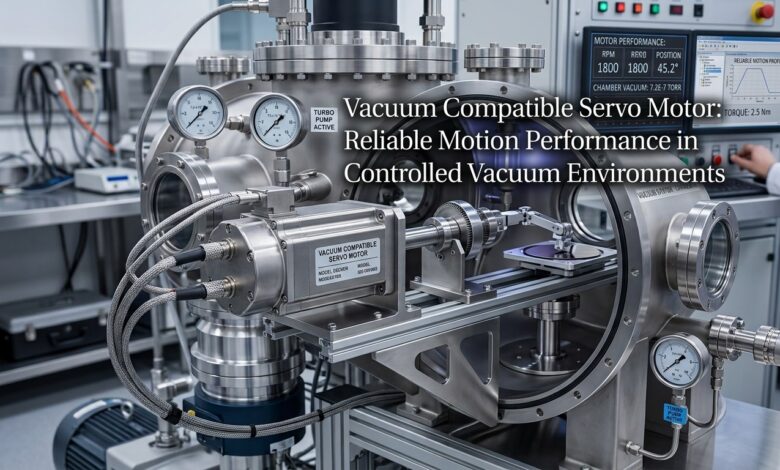
Modern automation increasingly depends on motion systems that can perform accurately in environments far more demanding than a standard factory floor. Vacuum chambers, controlled-process equipment, scientific instruments, and advanced manufacturing systems all create unique operating conditions where ordinary motors may struggle. A Vacuum Compatible Servo Motor is designed to provide precise, repeatable movement while addressing the challenges created by reduced pressure, limited convection cooling, material outgassing, and strict contamination requirements. These motors help engineers maintain controlled speed, torque, and positioning in applications where even a small mechanical or environmental inconsistency can influence results. By combining servo feedback with materials and construction suited to vacuum operation, this type of motor supports reliable automation in equipment that demands both cleanliness and precision.
Vacuum environments change the behavior of motion components in ways that are easy to underestimate. Heat that would normally disperse through surrounding air must instead move through conductive paths or thermal radiation. Certain lubricants, coatings, plastics, and adhesives can release gases under reduced pressure, while bearings and insulation systems may face operating conditions very different from those found in ordinary machinery. For this reason, selecting a vacuum-compatible motor is not simply about choosing the correct torque or speed rating. Engineers must evaluate the entire operating environment, including pressure level, duty cycle, positioning accuracy, thermal limits, mechanical load, cable routing, feedback requirements, and cleanliness expectations. A carefully matched motor can improve process consistency, reduce maintenance challenges, and help equipment operate more predictably over long production or testing cycles.
Vacuum Compatible Servo Motor solutions from Kingsnitech can support precision motion requirements in controlled vacuum environments where dependable positioning and material compatibility are essential. These applications often require much more than a conventional motor adapted with a few minor changes, because the vacuum environment influences thermal behavior, mechanical clearances, lubrication, wiring, and long-term reliability. A purpose-designed servo solution allows equipment builders to combine responsive closed-loop control with construction techniques suitable for specialized low-pressure conditions. When motor sizing, feedback, mounting, and thermal management are considered together, the result can be a compact and efficient motion system capable of delivering repeatable performance in demanding vacuum-based equipment.
Why Vacuum Compatibility Matters
Vacuum compatibility affects every part of a motion system, from the motor housing to the smallest internal material. Under normal atmospheric conditions, many commonly used industrial components perform without difficulty because air provides cooling and because small amounts of released vapor are rarely a serious concern. Inside a vacuum chamber, however, contamination can become much more significant. Materials that release trapped gases or volatile compounds can affect sensitive processes, reduce chamber cleanliness, or interfere with optical and scientific equipment.
Thermal management is another major issue. As air pressure drops, convection becomes far less effective. A motor may therefore run hotter than expected even when its mechanical load has not changed. That temperature increase can influence winding performance, insulation life, bearing behavior, and nearby components.
A vacuum-compatible design addresses these challenges through careful material selection, suitable lubrication strategies, and mechanical construction that supports controlled heat transfer. The objective is not simply to survive in a vacuum but to maintain reliable motion quality throughout repeated operating cycles. When these factors are handled correctly, servo technology can deliver the same fundamental benefits expected in advanced automation—accurate positioning, responsive speed control, and repeatable movement—while also respecting the environmental requirements of the chamber.
Precision Through Closed-Loop Servo Control
One of the key strengths of servo technology is its ability to measure and correct movement continuously. In a closed-loop system, a feedback device monitors the motor’s actual position or speed and sends that information to the controller. The controller compares the measured result with the commanded movement and adjusts the motor output whenever a difference appears.
This approach is especially useful in vacuum applications because mechanical resistance can change with temperature, bearing conditions, or load variations. Rather than relying on a fixed input and assuming that the motor moves exactly as expected, the servo system constantly verifies performance.
A Vacuum Compatible Servo Motor can therefore support applications that require fine positioning, smooth acceleration, controlled deceleration, and stable holding torque. This can be valuable in positioning stages, inspection platforms, robotic mechanisms, coating equipment, measurement systems, and scientific instruments.
The combination of accurate feedback and controlled motor response can also reduce unnecessary vibration. Sensitive processes may be affected by abrupt changes in speed or excessive mechanical oscillation, so smooth motion profiles are often just as important as final positioning accuracy. Proper tuning allows the motor to respond quickly while maintaining stable movement.
Thermal Management in Reduced-Pressure Environments
Heat control is one of the most important considerations when designing a motor system for vacuum use. In ordinary machinery, surrounding air removes a portion of the heat generated by motor windings and moving components. In a vacuum environment, that cooling mechanism becomes much weaker, so heat must be transferred primarily through conduction and radiation.
Mounting design can therefore play a major role in overall performance. A motor attached to a thermally conductive structure may be able to transfer heat away more effectively than one installed with limited contact area. Equipment designers often need to consider the entire mechanical assembly as part of the thermal path.
Motor sizing matters as well. An undersized motor may need to operate at high current for long periods, increasing heat generation. On the other hand, a significantly oversized motor can introduce unnecessary mass and space requirements. Selecting a motor that matches the real torque and duty-cycle requirements helps create a better balance between performance and thermal efficiency.
Control tuning can further improve thermal behavior. Smooth acceleration profiles, appropriate current limits, and stable servo settings can reduce unnecessary energy consumption and minimize repeated corrective movement. In a well-designed system, mechanical engineering and control strategy work together to keep operating temperatures within acceptable limits.
Materials, Lubrication, and Cleanliness
Clean operation is often a central requirement in vacuum-based equipment. Materials that are perfectly acceptable in normal industrial settings may not be suitable in reduced-pressure environments. Some plastics, adhesives, oils, coatings, and insulation materials can release gases or vapors that contaminate the chamber.
This makes material selection a critical part of vacuum motor design. Bearings, internal wiring, structural components, cable insulation, varnishes, and lubricants all need to be evaluated for the intended operating conditions. Lubrication deserves particular attention because conventional grease may behave differently under vacuum or may contribute to unwanted contamination.
A properly selected motor can reduce these risks by using materials and construction methods that are better suited to controlled environments. The surrounding mechanical system should follow the same philosophy. Cables, connectors, couplings, mounting hardware, and nearby components should all be chosen with vacuum cleanliness in mind.
Kingsnitech can be considered when developing applications that require accurate servo motion together with vacuum-compatible construction and controlled environmental performance. Treating cleanliness as a system-level requirement rather than a single-component feature can make the entire machine more dependable.
Common Applications for Vacuum Servo Technology
Vacuum-compatible servo motors can be used across a wide range of advanced systems. Scientific research equipment often requires precise movement of samples, sensors, mirrors, or measurement devices inside a controlled chamber. Manufacturing equipment may use servo-driven stages to move workpieces through coating, inspection, or processing operations. Automated transfer systems can also benefit from compact motors located close to the mechanism they drive.
Typical applications include:
- Precision positioning stages inside vacuum chambers.
- Optical adjustment systems requiring smooth, repeatable movement.
- Inspection and scanning equipment for controlled measurement tasks.
- Coating and deposition systems where workpiece positioning is important.
- Vacuum robotics used for part handling and automated transfer.
- Scientific instruments requiring stable motion during experiments.
- Testing systems that evaluate components under controlled pressure.
In each case, the motor must do more than generate motion. It must provide that motion while maintaining the environmental conditions needed by the application. This combination of mechanical performance and vacuum compatibility is what makes specialized servo technology so valuable.
Selecting the Right Vacuum Compatible Servo Motor
Motor selection should begin with a detailed understanding of the real operating requirements. Torque and speed are essential, but they should never be considered in isolation. Engineers also need to evaluate vacuum level, load inertia, acceleration, duty cycle, required positioning accuracy, motor temperature, installation space, and feedback resolution.
Continuous torque determines the load the motor can sustain over longer operating periods, while peak torque becomes important during rapid acceleration or sudden load changes. Load inertia influences how quickly the system can start, stop, or reverse without overshoot.
Mechanical integration is equally important. Shaft dimensions, mounting geometry, coupling selection, and alignment can all influence performance. Poor alignment may create extra bearing loads or vibration, reducing the benefits of a precision servo system.
Cable routing and feedthrough arrangements should also be planned early. Vacuum chambers often have limited access, so wiring decisions made late in the design process can create unnecessary complexity. A well-integrated design considers mechanical, thermal, electrical, and vacuum requirements together rather than treating them as separate problems.
Advantages for Advanced Automation
Vacuum-compatible servo motors offer several advantages for modern automated systems. One of the most important is repeatability. Automated equipment often performs the same movement thousands of times, so consistent positioning helps maintain stable process quality.
Another advantage is programmability. Servo-controlled systems can adjust position, speed, acceleration, and torque through software rather than requiring major mechanical changes. This makes equipment more flexible and allows a single platform to support different process conditions or operating modes.
Placing the motor directly inside the vacuum chamber can also simplify some mechanical designs. Instead of transmitting motion through long shafts, seals, or complex external linkages, the motor can sometimes be positioned closer to the driven mechanism. This may reduce backlash, improve responsiveness, and simplify the overall architecture.
A well-designed Vacuum Compatible Servo Motor system can therefore support higher precision, cleaner integration, greater automation flexibility, and more consistent performance. These benefits are especially valuable in applications where uptime, accuracy, and process control are closely connected.
Building a Reliable Complete Motion System
The motor is only one element of a successful vacuum motion solution. Feedback devices, controllers, cables, bearings, couplings, mounting structures, and thermal paths all contribute to final performance. A high-quality motor can still deliver disappointing results if the surrounding system is poorly aligned, inadequately cooled, or improperly tuned.
Testing under realistic operating conditions is therefore essential. Atmospheric testing can confirm basic functionality, but vacuum testing provides a more accurate picture of thermal behavior, positioning performance, vibration, and mechanical response. Engineers can use this information to refine control settings and improve system stability.
Preventive monitoring can also support long-term reliability. Changes in motor current, positioning error, vibration, or load behavior may indicate developing mechanical issues. Identifying these trends early can help reduce unexpected downtime and make maintenance more predictable.
Solutions from Kingsnitech can support equipment designers who need to combine precise servo motion with the environmental requirements of controlled vacuum applications. A system-level approach helps ensure that each component contributes to the same goals: accuracy, cleanliness, stability, and dependable operation.
Reliable Precision for Controlled Vacuum Environments
As vacuum-based automation becomes more advanced, the expectations placed on motion systems continue to grow. Equipment may need to achieve tighter positioning tolerances, faster response, lower contamination, and higher repeatability without compromising the controlled environment around it. Vacuum-compatible servo technology provides a practical way to meet these demands.
The strongest systems are designed around the complete operating environment. Engineers who account for pressure level, material compatibility, heat transfer, mechanical alignment, feedback resolution, load characteristics, and control tuning can create motion systems that remain stable through demanding operating cycles.
A properly selected vacuum servo solution can help reduce contamination risks, improve positioning quality, and support more compact mechanical designs. It can also give equipment developers greater flexibility when creating advanced scientific, manufacturing, testing, or automation systems. By treating vacuum compatibility and precision control as equally important requirements, designers can build machines that perform reliably where ordinary motion components may fall short.
Explore available precision motion solutions at https://www.kingsnitech.com/products/.