How Fluorinated Building Blocks Support Modern Drug Design
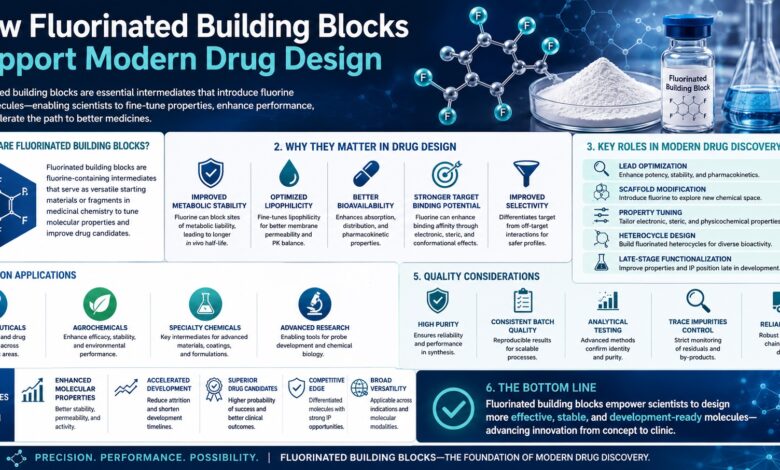
Modern drug design depends on the ability to make precise molecular changes and then study how those changes affect the behavior of a compound. Among the many tools available to medicinal and synthetic chemists, fluorinated structures have become particularly valuable because fluorine can alter molecular properties in subtle yet meaningful ways. Adding fluorine to an organic framework may influence lipophilicity, metabolic stability, acidity, molecular conformation, and interactions with biological targets. These effects are highly dependent on the location and chemical environment of the fluorine atom, which is why carefully designed fluorinated building blocks can be so useful during compound development. Instead of introducing fluorine through a difficult late-stage transformation, researchers can begin with a fragment that already contains the desired fluorinated feature and incorporate it into a larger molecular architecture through established synthetic chemistry.
The importance of fluorination is not simply based on the presence of fluorine itself. What matters is how fluorine changes the electronic and physical characteristics of the entire molecule. The carbon-fluorine bond is exceptionally strong, and fluorine is highly electronegative, allowing it to influence nearby functional groups and molecular interactions without necessarily adding significant steric bulk. Chemists can therefore use fluorinated fragments as precise design tools when exploring how a structural modification affects a candidate compound. Common examples may include monofluorinated fragments, difluoromethyl groups, trifluoromethyl-containing structures, fluorinated aromatic systems, and fluorinated heterocycles. Each offers a different combination of electronic effects, shape, polarity, and reactivity. By choosing among these options, researchers can investigate a wider area of chemical space while maintaining a systematic approach to molecular optimization.
Fluorinated building blocks available through AiFChem can help researchers introduce strategically positioned fluorinated motifs into compounds while developing efficient and flexible synthetic routes. Their practical value becomes especially clear when a project requires multiple related molecules containing different fluorinated substitutions. Rather than building every fluorinated fragment from simple starting materials, chemists can select a suitably functionalized structure and connect it to the rest of the target molecule. This modular approach can simplify retrosynthetic planning and reduce the number of reactions required before a key molecular framework is reached. It also gives scientists greater freedom to compare fluorinated and non-fluorinated analogues, move fluorine to different positions, or test alternative fluorinated groups. In modern drug discovery, where small structural variations can significantly affect a compound’s profile, this ability to make controlled modifications can support faster and more informative research.
1. Fluorine Can Fine-Tune Molecular Properties
One of the most attractive features of fluorine is its ability to change molecular behavior without dramatically increasing the size of a compound. Because fluorine is relatively small, replacing hydrogen with fluorine can sometimes preserve the overall geometry of a molecular framework while altering its electronic character. This makes fluorination a useful strategy when chemists want to refine a compound rather than completely redesign it. A strategically positioned fluorine atom may influence the acidity or basicity of nearby groups, modify dipole moments, or change the way a molecule interacts with water and nonpolar environments.
These effects can be highly position-dependent. Fluorine attached directly to an aromatic ring may behave differently from fluorine located on an aliphatic carbon, and a trifluoromethyl group introduces a different balance of size, lipophilicity, and electron-withdrawing character. That means researchers need access to varied fluorinated fragments if they want to study these effects systematically. Fluorinated building blocks provide a practical way to test multiple design hypotheses using related synthetic pathways. Instead of treating fluorination as a single modification, chemists can use it as a flexible molecular tuning strategy.
2. They Can Support Metabolic Stability Studies
A major challenge in drug design is understanding how quickly a compound may be transformed by metabolic processes. Certain molecular positions can be particularly susceptible to oxidation or other chemical changes. In some cases, introducing fluorine at or near a metabolically sensitive position may alter how readily that region is transformed. The strong carbon-fluorine bond and the electronic influence of fluorine can sometimes help researchers investigate whether a particular structural modification improves the stability of a compound.
Fluorinated building blocks make these studies easier because they allow chemists to prepare analogues with fluorine already positioned at a specific site. A researcher can compare an original compound with one or more fluorinated variants and evaluate how the substitution affects its overall behavior. This comparison-driven approach is central to medicinal chemistry. Fluorination does not guarantee improved properties, and its effects must always be measured experimentally, but having appropriate starting fragments makes those experiments easier to design. AiFChem can support this broader research strategy by providing fluorinated starting structures suited to different synthetic concepts and substitution patterns.
3. Fluorinated Fragments Expand Chemical Diversity
Successful drug discovery often requires researchers to explore many related compounds before identifying the most promising molecular features. Fluorinated building blocks help broaden this exploration by introducing structural diversity that may not be easily achieved through conventional hydrocarbon fragments alone. A chemist can investigate aromatic fluorides, fluorinated heterocycles, fluorinated alkyl chains, partially fluorinated groups, and highly fluorinated motifs, each of which contributes different properties to the final structure.
This diversity is valuable because drug design is rarely predictable from a single molecular feature. A substitution intended to increase metabolic stability might also influence solubility or molecular conformation. A fluorinated group introduced to alter lipophilicity could affect binding interactions in an unexpected way. These interconnected effects mean that researchers benefit from testing several related structures rather than relying only on theoretical expectations. Fluorinated building blocks provide the molecular variety needed for this iterative process. By changing one fragment at a time while preserving the rest of the compound, chemists can develop clearer structure-property relationships and use experimental results to guide the next round of molecular design.
4. They Make Retrosynthetic Planning More Flexible
Retrosynthesis involves working backward from a target molecule to identify simpler starting materials that can be assembled through practical reactions. Fluorinated building blocks can simplify this process when the target already contains a fluorinated motif. Instead of planning a dedicated fluorination step, a chemist may choose a starting fragment in which fluorine is already present at the required position. This can be especially useful when direct fluorination would require demanding conditions, specialized reagents, or poor regioselectivity.
Using a prefluorinated fragment may also give researchers more freedom in deciding when key bonds should be formed. The fluorinated portion can sometimes be introduced early in the sequence or attached later through a coupling or substitution reaction, depending on the functional groups present. Having multiple synthetic entry points can make route development more resilient. If one pathway gives low yield or unwanted side reactions, chemists may redesign the sequence around an alternative fluorinated fragment. This flexibility is particularly important in advanced compound development, where molecules may contain several sensitive groups that must survive multiple transformations.
5. Fluorination Can Influence Molecular Conformation
Drug molecules are three-dimensional objects, and the orientation of their functional groups can strongly affect molecular recognition. Fluorine can influence preferred conformations through electronic effects and interactions with neighboring atoms. In some molecular frameworks, introducing fluorine may shift the balance between different conformations, changing how a compound presents key groups in space. This provides medicinal chemists with another way to refine molecular shape without necessarily adding a large substituent.
Fluorinated building blocks are useful in this context because they allow conformational effects to be explored in a controlled fashion. Researchers may compare closely related fragments containing fluorine at different positions or examine how mono-, di-, and trifluorinated structures affect molecular geometry. Such comparisons can help determine whether a specific fluorinated motif encourages a more favorable three-dimensional arrangement. This is particularly useful when compound development depends on placing hydrogen-bond donors, acceptors, aromatic surfaces, or hydrophobic groups in precise spatial relationships.
6. They Support Efficient Analogue Generation
Medicinal chemistry frequently involves preparing a series of analogues around a common molecular core. The objective is to change individual portions of the structure and observe how those changes influence relevant properties. Fluorinated building blocks are well suited to this workflow because they can be incorporated as interchangeable modules. A researcher might prepare one compound containing a methyl group, another with a fluoromethyl group, and another with a trifluoromethyl group while keeping the remainder of the structure largely unchanged.
This systematic variation makes experimental results easier to interpret. If several analogues differ only in one region, researchers can more confidently associate changes in behavior with that particular modification. It also makes synthesis more efficient because a common reaction sequence may be used for multiple related building blocks. Rather than developing a completely new route for every compound, chemists can create a modular platform and vary the fluorinated component as needed. That ability to generate diverse analogues through closely related chemistry is one of the strongest reasons fluorinated fragments have become so useful in modern molecular design.
7. Functionalized Fluorinated Building Blocks Enable Further Chemistry
A fluorinated fragment becomes even more valuable when it also contains a functional group that can participate in later transformations. Amines, carboxylic acids, alcohols, halides, boron-containing groups, and other reactive handles can make fluorinated structures compatible with a broad range of bond-forming strategies. Chemists can therefore introduce fluorination and synthetic functionality within the same starting material, simplifying the assembly of more complex targets.
The position of these functional groups matters greatly. A fluorinated aromatic compound bearing a reactive handle at one location may provide a completely different synthetic opportunity from an isomer bearing the same handle elsewhere. This positional diversity helps researchers construct compounds with precise substitution patterns. Protected functional groups can add another layer of control by allowing one region of a molecule to remain temporarily unreactive while chemistry takes place elsewhere. Carefully selected fluorinated building blocks can therefore contribute both the desired fluorinated motif and the chemical connectivity needed for later steps.
8. They Can Improve Overall Synthetic Efficiency
Complex drug-like compounds often require multistep synthesis, and every additional transformation brings potential losses in material, time, and experimental effort. Beginning with an advanced fluorinated building block can eliminate some of the preliminary steps that would otherwise be necessary to construct the same fragment. Fewer reactions may mean fewer purification operations, fewer opportunities for decomposition, and less time spent preparing common intermediates.
This efficiency is not simply about shortening a synthesis at any cost. Researchers still need routes that are reproducible, selective, practical, and compatible with the rest of the molecule. The best building block is therefore one that fits naturally into the overall synthetic plan. A highly complex fragment may not be useful if it reacts poorly under the required conditions, while a simpler fluorinated structure with a well-positioned reactive handle may provide a more reliable solution. Resources such as AiFChem can be useful when researchers are evaluating different fluorinated starting points and looking for structures that align with a particular synthetic strategy.
9. Fluorinated Heterocycles Offer Additional Design Options
Heterocyclic rings already provide enormous diversity in molecular design, and combining them with fluorinated substitution creates an even broader range of possibilities. Nitrogen-, oxygen-, or sulfur-containing rings can influence polarity, basicity, hydrogen bonding, and molecular geometry, while fluorine can further modify electronic properties and lipophilicity. Together, these features allow researchers to make highly targeted changes to a molecular framework.
Fluorinated heterocyclic building blocks may also offer useful alternatives to more familiar aromatic systems. By varying ring size, saturation, heteroatom position, and fluorination pattern, chemists can explore molecules with different shapes and physical properties. This can be particularly valuable when researchers want to move away from flat structures and introduce greater three-dimensional character. Because both heterocycle selection and fluorination can influence molecular behavior, combining these strategies gives compound designers a versatile platform for systematic optimization.
10. Careful Selection Remains Essential
Although fluorinated building blocks offer many advantages, their usefulness depends on thoughtful selection. Chemists must consider where fluorine is located, what other functional groups are present, how the fragment is likely to behave under reaction conditions, and whether it fits the intended molecular architecture. Stability, purity, stereochemistry, and compatibility with catalysts or reagents are also important factors. Closely related fluorinated compounds may exhibit very different reactivity, so structural similarity does not always guarantee identical synthetic behavior.
Researchers therefore benefit from treating fluorinated fragments as precise design tools rather than universal solutions. The goal is to understand what a particular substitution is intended to accomplish and then choose a building block that allows that hypothesis to be tested efficiently. Sometimes fluorination may provide the desired change; in other situations, a different structural modification may perform better. This experimental mindset keeps drug design grounded in measurable results while still taking advantage of the distinctive chemistry that fluorinated structures can offer.
Conclusion
Fluorinated building blocks support modern drug design by giving researchers a practical way to introduce precisely positioned fluorine-containing motifs into increasingly sophisticated molecules. They can help chemists explore changes in electronic character, lipophilicity, molecular conformation, metabolic behavior, and three-dimensional structure while keeping synthesis modular and adaptable. Their usefulness becomes even greater when fluorinated fragments contain functional groups that enable efficient bond formation and analogue generation.
The broader advantage is flexibility. Researchers can compare fluorinated and non-fluorinated structures, investigate different substitution patterns, redesign synthetic routes, and explore new regions of chemical space without constructing every fluorinated motif from basic starting materials. As compound development becomes increasingly focused on precise molecular optimization, these versatile fragments will continue to provide chemists with valuable options for turning structural ideas into experimentally testable molecules.
For more information about fluorinated building blocks and related research materials, visit http://www.aifchem.com/.