Automatic Napkin Machine Selection Guide for Growing Tissue Businesses
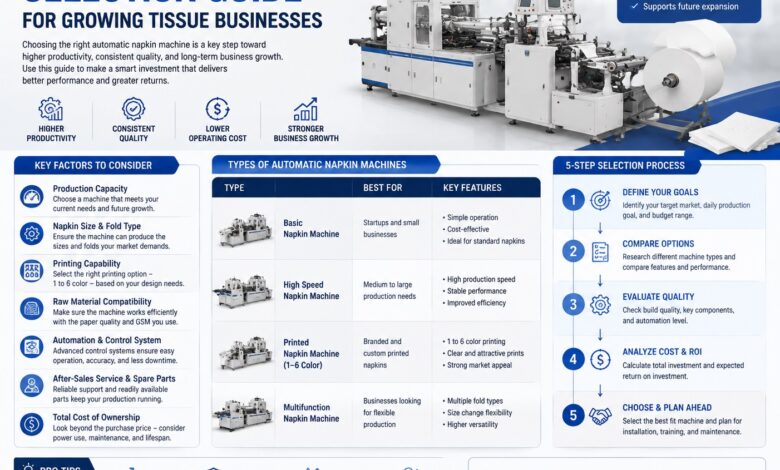
A growing tissue business eventually reaches a point where manual processes or basic equipment can no longer keep up with demand. Orders become larger, customers expect more consistent quality, and production delays start affecting profitability. Choosing the right automatic napkin machine can solve these challenges by increasing output, improving product uniformity, and reducing dependence on repetitive manual labor. The goal is not simply to buy the fastest machine available, but to select equipment that matches your current operation while leaving enough room for future expansion.
The selection process becomes easier when you focus on practical production requirements rather than technical specifications alone. Machine speed matters, but so do folding accuracy, embossing quality, raw material compatibility, maintenance needs, and operator convenience. A balanced machine can help a growing tissue business deliver attractive napkins consistently without creating unnecessary operating complexity. By evaluating each factor carefully, you can make a confident investment that supports stable production and long-term business development.
Automatic Napkin Machine solutions from cx-tissuemachine can provide growing tissue businesses with an efficient path toward reliable folding, consistent output, and smoother daily production. Modern machines combine several operations within one coordinated production line, allowing tissue material to move through feeding, embossing, folding, counting, and cutting stages with limited manual handling. This integrated approach helps reduce variation between finished napkins while making production planning more predictable. For a business preparing to serve larger customers or expand its product range, that consistency can become a valuable competitive advantage.
1. Begin With Your Actual Production Requirements
Before comparing machine models, calculate how many napkins your business realistically needs to produce during an ordinary shift. Avoid selecting equipment based only on your busiest week or your most optimistic sales forecast. Instead, review current orders, expected growth, working hours, product sizes, and the number of shifts you plan to operate. This gives you a practical output target that can guide the rest of the purchasing decision.
A machine with modest excess capacity is often a sensible choice because it allows room for sales growth and seasonal demand. However, buying equipment with far more capacity than you can use may increase the initial investment, power consumption, and maintenance burden without providing an immediate return. The ideal machine should run efficiently at your normal production level while retaining enough additional capacity to handle larger future orders.
Consider these basic questions:
- How many napkins are currently required each day?
- How quickly are customer orders increasing?
- Will the machine run for one shift or several shifts?
- How much temporary downtime can the business tolerate?
- Are you supplying standard napkins or multiple specialized products?
Clear answers will prevent you from paying for unnecessary features or selecting a machine that becomes too limited after a short period.
2. Understand the Complete Production Process
An automatic napkin production line performs more than one simple task. Depending on its configuration, the machine may unwind the parent tissue roll, control material tension, emboss patterns, print designs, fold the tissue, count the finished pieces, and cut or separate them into organized groups. Understanding these stages helps you identify which functions are essential for your business and which are optional.
The feeding system should maintain stable tissue movement because inconsistent tension can lead to wrinkles, uneven folds, or frequent material breaks. The embossing section adds texture and may improve both appearance and absorbency. Folding units shape the tissue into the required format, while counting and cutting systems organize production into accurate quantities.
When these sections work in harmony, the machine produces a steady stream of uniform napkins. When one section is poorly matched with another, small problems can spread across the entire line. For that reason, evaluate the machine as a complete system rather than focusing on a single attractive feature.
3. Choose the Right Production Speed
Machine speed is usually presented as the number of napkins produced per minute. A higher figure can look impressive, but maximum speed does not always represent normal operating performance. Production speed may vary according to tissue thickness, folding style, embossing pressure, printing requirements, operator experience, and raw material quality.
Ask about the machine’s stable operating speed, not just its theoretical maximum. A machine that consistently runs at a slightly lower speed may produce more usable napkins during a full shift than a faster machine that requires frequent adjustments. Consistency reduces waste, protects product quality, and makes delivery schedules easier to manage.
You should also consider the equipment connected before and after the napkin machine. If packaging remains largely manual, extremely high production speed may create a bottleneck. Finished napkins could accumulate faster than workers can pack them, increasing the risk of damage or contamination. The most productive line is one in which forming, counting, handling, and packaging capacities are properly balanced.
4. Check Napkin Size and Folding Flexibility
Tissue markets often require more than one napkin size. Restaurants may prefer compact napkins, event suppliers may request larger decorative products, and household buyers may want different fold styles. Selecting a machine with suitable size flexibility can help your business respond to these opportunities without purchasing another complete production line.
Confirm the minimum and maximum tissue width the machine can process. You should also verify which finished dimensions and folding patterns are supported. Common configurations include quarter folds, rectangular folds, and other customized formats. Some changes may require only simple adjustments, while others may involve replacement parts or additional folding components.
Changeover time is equally important. A flexible machine loses some of its value when switching sizes requires many hours of difficult mechanical work. Look for a design that allows operators to make controlled adjustments with clear measurement points and accessible controls. Faster changeovers help small and medium-sized businesses accept varied orders while keeping downtime under control.
5. Evaluate Embossing Quality
Embossing gives napkins texture, visual character, and a more substantial feel. It can also help multiple tissue layers remain together during folding and use. Because customers often judge tissue products through touch and appearance, embossing quality can directly influence how they perceive the finished napkin.
Inspect the embossing system carefully. The pattern should appear clean and even across the entire sheet without tearing, crushing, or weakening the material. Pressure should remain stable during extended operation, especially when processing lightweight tissue. Uneven embossing can make one side of the napkin look sharp while the other appears faint or distorted.
The machine should also allow reasonable pressure adjustments for different raw materials. A setting that works well with one tissue grade may damage another. Flexible adjustment gives the operator more control and helps the business use a wider range of tissue specifications. Where decorative patterns are important, ask whether embossing rollers can be changed and how much time the replacement process requires.
6. Decide Whether Printing Is Necessary
Printed napkins can open opportunities in hospitality, events, celebrations, catering, and customized orders. However, printing also adds another technical process that must be managed carefully. Before selecting a printing configuration, consider whether customer demand justifies the added investment and operating requirements.
A basic color-printing unit may be enough for simple patterns, logos, or decorative designs. More complex printing requires accurate alignment, stable ink transfer, and careful control of tissue tension. Because tissue is soft and absorbent, printing performance depends on proper machine setup as well as suitable materials.
Evaluate print clarity at normal production speed. A sample produced slowly for demonstration purposes may not represent everyday performance. Check whether the printed area remains aligned after folding and whether the design stays consistent throughout a longer production run. Easy cleaning is another useful feature because fast color changes can reduce downtime between customized orders.
For businesses focused primarily on plain napkins, a non-printing configuration may provide a simpler and more economical starting point. Printing can be added when there is a clear market for higher-value products.
7. Confirm Raw Material Compatibility
An automatic napkin machine must handle the tissue material available to your business. Parent roll width, roll diameter, core size, basis weight, number of layers, softness, and tensile strength can all affect machine performance. A machine that performs smoothly with one material may require adjustments when using a softer, thinner, or more delicate tissue.
Provide accurate raw material specifications before finalizing your selection. Ask whether the feeding and tension systems can accommodate normal variation between rolls. Stable tension control is particularly important because excessive force can tear the tissue, while insufficient control may cause wrinkles or inaccurate folds.
Material efficiency should also be considered. Even a small percentage of avoidable waste becomes significant during continuous production. Clean edge control, accurate cutting, proper tension, and reliable folding help convert more of every parent roll into saleable products. Better material utilization improves profitability without requiring higher selling prices or faster machine speeds.
8. Examine Automation and Control Features
Modern control systems can make a napkin machine easier to operate, monitor, and adjust. A clear control panel allows operators to start production, set speeds, review counts, and respond to alerts from one central location. This reduces guesswork and helps new operators learn the production process more quickly.
Look for controls that display useful information in a simple format. Complicated screens filled with unnecessary settings can slow down daily work. Important parameters should be easy to find, while sensitive technical settings should be protected from accidental changes.
Automatic counting is especially valuable because it helps prepare consistent quantities for packaging. Sensors may also detect tissue breaks, feeding problems, open guards, or abnormal operating conditions. When the machine stops promptly after detecting an issue, it can reduce waste and protect equipment.
Automation should make operation more dependable, not more confusing. The best control system is one that supports efficient production while still allowing trained operators to understand what the machine is doing.
9. Prioritize Finished Product Consistency
High output has little value when a large percentage of napkins must be rejected. Finished products should have uniform dimensions, straight edges, accurate folds, balanced embossing, and consistent sheet counts. These details affect packaging efficiency and customer satisfaction.
Request samples produced with tissue similar to the material you plan to use. Examine a large group of napkins rather than one carefully selected piece. Stack them together to check whether the edges align and whether the folded thickness remains consistent. Open several samples to inspect cutting accuracy and embossing quality.
Consistency also influences brand presentation, even when the napkins are sold in simple packaging. Neatly folded products create a stronger impression of cleanliness and care. Reliable quality can encourage repeat orders and help a growing tissue business build trust with wholesalers, retailers, restaurants, and institutional customers.
10. Review Safety and Operator Convenience
A productive machine should also support safe, comfortable daily operation. Moving rollers, cutting sections, drive components, and electrical systems need appropriate protection. Emergency stops should be clearly visible and easy to reach from normal working positions. Access doors and protective covers should prevent accidental contact while still allowing authorized maintenance.
Operator convenience has a direct effect on efficiency. Tissue rolls should be reasonably easy to load, controls should be placed at a comfortable height, and common adjustment points should remain accessible. When routine tasks are unnecessarily difficult, changeovers take longer and operators may be more likely to make mistakes.
Clear operating procedures and structured training are equally important. Workers should understand startup, shutdown, cleaning, adjustment, and emergency procedures. A well-designed automatic machine can reduce heavy manual work, but good training ensures that its automation is used correctly and safely.
11. Consider Maintenance Before Purchasing
Every production machine requires routine care. The difference lies in how easily that care can be completed and how much downtime it creates. Before choosing equipment, inspect access to bearings, belts, rollers, cutting components, sensors, lubrication points, and electrical cabinets.
Daily cleaning should be straightforward because tissue dust can accumulate around moving parts and sensors. Components that require regular adjustment should be accessible without dismantling large sections of the machine. Clear maintenance schedules help operators perform preventive tasks before minor wear becomes an expensive stoppage.
Ask for a recommended spare-parts list covering both routine wear items and critical components. Keeping selected parts on hand can reduce downtime when replacement becomes necessary. It is also helpful to organize records for cleaning, inspection, lubrication, repairs, and component changes. Maintenance records reveal recurring issues and support more accurate production planning.
A machine that is easy to maintain will usually deliver stronger long-term value than equipment designed only to achieve an impressive headline speed.
12. Measure Space, Power, and Utility Requirements
Production equipment must fit the actual factory environment. Measure the available floor area carefully, including room for the machine, electrical cabinets, operator access, parent roll movement, finished product handling, maintenance work, and packaging activities.
Do not place equipment too close to walls or other machines. Technicians may need access from several sides during servicing. Adequate working space also improves material flow and reduces the chance of napkins being damaged during transfer.
Confirm electrical requirements, including voltage, frequency, total power demand, and connection type. Depending on the machine configuration, compressed air or other utilities may also be needed. These requirements should be checked before delivery so that installation work does not delay production.
A well-planned layout allows raw materials to enter from one side, move through production logically, and reach the packaging area without unnecessary handling. Smooth workflow saves time every day and helps maintain a cleaner, more organized workplace.
13. Compare Total Cost Instead of Purchase Price Alone
The lowest purchase price does not always produce the lowest production cost. A complete financial comparison should include installation, transportation, operator training, power consumption, tissue waste, maintenance, spare parts, labor requirements, output stability, and expected service life.
A reliable automatic napkin machine can create savings through several channels. It may reduce manual handling, improve counting accuracy, limit waste, increase daily output, and allow the business to accept larger orders. These benefits can be more important than a small difference in initial price.
Calculate the expected cost per finished napkin under realistic operating conditions. Include normal downtime and material waste rather than assuming perfect production every hour. You can then compare this figure with your expected selling price and order volume.
Payback should be evaluated conservatively. A sensible estimate gives the business a clearer picture of cash flow and makes it easier to plan future expansion.
14. Plan for Business Growth
The right machine should support where your business is going, not only where it is today. Consider whether future customers may request different dimensions, printed designs, stronger embossing, additional layers, higher quantities, or more advanced packaging.
A modular or adjustable configuration can make expansion easier. However, flexibility should remain practical. Paying for many features that are unlikely to be used can increase complexity without improving revenue. Focus on capabilities that match realistic market opportunities.
Production records can guide future decisions. Track output, waste, downtime, product types, order sizes, and customer preferences after installation. These records will show when the machine is approaching full capacity and which upgrades could deliver the greatest benefit.
Growth becomes more manageable when equipment decisions are made as part of a broader production strategy. A dependable machine, trained operators, stable raw material supply, organized maintenance, and efficient packaging all contribute to sustainable expansion.
Final Selection Checklist
Before approving your purchase, confirm that the machine meets the following priorities:
- Suitable output: Stable production capacity matches present demand and expected growth.
- Product flexibility: Required napkin sizes, folds, layers, and embossing patterns are supported.
- Material compatibility: The machine can process your available parent tissue rolls reliably.
- Consistent quality: Folding, cutting, counting, and embossing remain accurate during longer runs.
- Practical automation: Controls and sensors improve operation without creating unnecessary complexity.
- Safe design: Guards, emergency stops, and operating procedures protect workers.
- Easy maintenance: Routine cleaning and component access can be handled efficiently.
- Balanced workflow: Production speed fits packaging capacity, available space, and factory utilities.
- Reasonable operating cost: Energy use, waste, labor, and maintenance support profitable production.
- Expansion potential: The configuration can accommodate realistic future products and order volumes.
Conclusion
Selecting an automatic napkin machine is an important step for any tissue business moving toward higher production and more consistent quality. The strongest decision comes from balancing speed, flexibility, material handling, embossing, controls, maintenance, safety, and operating cost. Instead of being distracted by a single specification, study how the entire machine will perform during an ordinary working day.
A suitable machine can help reduce repetitive labor, improve product presentation, control tissue waste, and create dependable output for expanding orders. It can also give the business greater confidence when approaching new customers or introducing additional napkin formats. With careful planning, realistic capacity calculations, and close attention to product quality, automation becomes more than an equipment upgrade—it becomes a practical foundation for sustainable growth.
For additional machine information and production ideas, visit https://www.cx-tissuemachine.com/.